
Selfies and Roosters
Our “Little Gray” hen hatched out five peeps in late June. Unfortunately, one of them had a bad leg, and while she could hop around, she couldn’t roost. After about eight weeks, we had to move her on to greener pastures. Of the remaining youngsters, it appears we have at least three roosters. About four weeks ago, I headed up to the coop for the weekly cleaning, and I found one of those cockerels (young roosters) hanging out in the coop. I kicked him out so I could clean, and as he ran down the ramp, all the other chickens started chasing him and pecking at him. When I intervened, he was crammed up in the corner of the run. I picked him up and found that he was pecked raw and nearly lifeless.
At this point, I decided he needed to be moved to the smaller coop just 20 feet from where I stood. All I needed to do was open the coop gate, walk the 20 feet to the other coop, open that gate, and put him inside. But this simple journey became a bit of an obstacle course, because I had two very interested retrievers who wanted to help. Now, if I had expected to be handling chickens and moving them from one coop to another, I wouldn’t have brought the dogs, but this was the situation I found myself in.
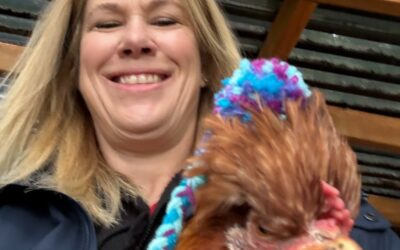
So, I stood there, contemplated the situation, and did what anyone would: I took a selfie. No, I did. But then I realized I was stuck. There was no way I would be able to handle this situation alone. I could either set the cockerel down and take the dogs up to the house, risking further attacks on the cockerel, or I could phone a friend. So I called Mike and asked for his help. He came up and was able to pull the dogs away so I could move the injured cockerel to the other coop.
The Vulnerable Rooster
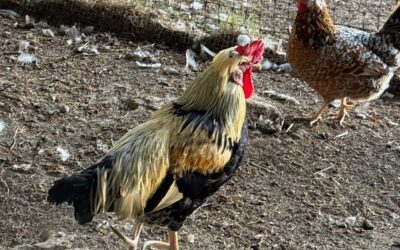
A few days ago I made my morning walk up to the chickens with the dogs. As I approached the gate, I saw Sven, our rooster, standing with his back to the gate in what appeared to be a protective stance. Sven is 2 years old and to date hasn’t been aggressive with me or the other hens. My first thought was that perhaps that “switch” had flipped in his head and he was ready to fight. I opened the gate and asked him if he was planning on moving. As I did, I realized his spur was caught in the chicken netting and he was stuck. He tried to free himself, but he couldn’t. He was so nervous with me so close that he kept trying to get away, making the situation worse.
I walked back to the house to get some snips and returned to the gate. I was hoping I could cut the netting from under the gate, but that didn’t work. So, I slowly eased myself into the coop and crouched down next to him, within about 12 inches. He stood completely still.
Slowly, I started to cut away the netting around his spur. After four cuts, he was able to free himself and run away. I watched him for a bit to make sure he wasn’t injured. He looked OK, but he wasn’t quite as “cocky” as he normally is.
I walked back to the house feeling pretty good about myself and saving my rooster. But then I started to think about him. He’d been stuck and had to succumb to my help in order to get free. I’m sure that was hard for him at some deep chicken level.
Chicken Peer Group
During a recent trip to Europe, I had a chance to meet up with our German friends and travel with them through Slovenia, Croatia, Czech Republic and Austria. They had visited us last summer and left inspired to get chickens. So, last October, Burkhart went to work building his chicken coop and eventually got his first chickens in May of this year. He had a lot of adventures as he began his journey to become Chicken Daddy, including outsmarting a clever chicken who learned how to escape the coop, dealing with broody hens and setting up the coop so the hens would lay eggs in the coop and not in random places on their property. During our recent travels, I shared some of the things I’ve learned in an effort to reduce his steep learning curve. After all the help I received from my chicken coach and the chicken whisperer, it felt good to help another aspiring chicken dad on his egg-laying journey.
The fact is there are always people who want to help others be successful in their endeavors, whether it be around raising chickens, traveling through Europe or running a business.
The Stages of Development
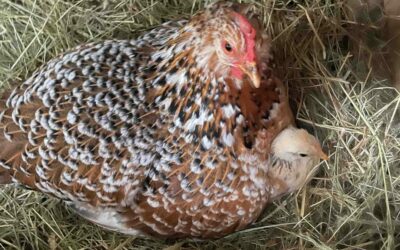
Have you heard the phrase, “Well, you’re no spring chicken?” As you can imagine, the subtext is that chickens are typically born in spring. For me, that means at least one of my chickens is going to be broody. In case you are a chicken novice, a “broody” hen wants to gather a clutch of eggs, incubate them and ultimately hatch them. The first step in this “broodiness” is gathering eggs to sit on until she has an appropriate number in her clutch.
In my experience, that “appropriate” number in a clutch can exceed 12 eggs. So we intervene. Considering the size of my coop and the number of potential broody hens, we have settled on six eggs being an ideal clutch size. Once a hen goes broody, we mark the designated eggs and then, on a daily basis, lift the broody hen up and remove all unmarked eggs from her clutch. Depending on the hen, her acceptance of this daily handling can vary from a quiet “growl” to all-out pecking at the handler. Other than occasionally leaving the coop to eat and poop, she will sit on her eggs for three weeks.
Let’s Celebrate
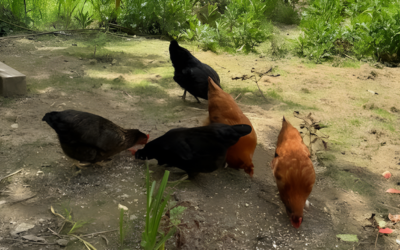
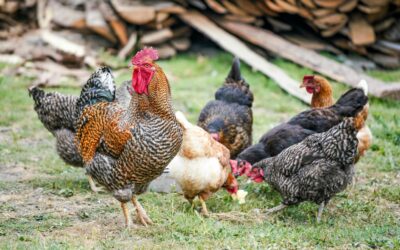
For some reason, when I introduce pullets into the greater flock, my older chickens seem to regress. They start chasing the pullets away from the food, squawking at each other, and in general not being very nice to the newcomers. I get they need to re-establish their pecking order, but do they really need re-learn how to be a kind chicken? My biggest frustration is that this means the new chickens are forced to sleep in the nesting boxes. When the younger hens try to jump onto the roosting bar, the older hens start pecking at them. Last summer, we ended up with four hens roosting on the bars and the remaining nine pullets crammed into the nesting boxes. While dogs don’t like to sleep in their pee or poop, apparently chickens don’t care. So we end up with messy nesting boxes, and “poopy” eggs.
Sally Vs. The Greater Good
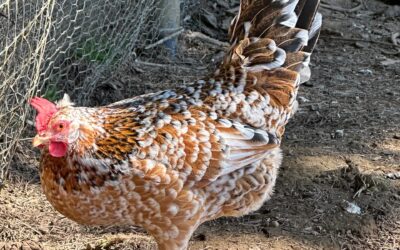
Sally, our lone survivor of the Great Chicken Massacre of May 2021, is a feisty hen. While Sven is at the top of my flock’s pecking order, I’d bet money that Sally is the top hen. I’ve seen her peck at the younger hens when they wanted to roost next to her at night or chase them away if they have a little morsel of treat that she wants for herself. Last year, she went broody in early spring, but we weren’t ready to add peeps to our flock. When I kicked her off her eggs every day to collect them, she would aggressively peck at me. This occurred every day for over 3 weeks until she finally gave up. She went broody two more times during the spring and summer before we finally agreed to let her hatch those eggs.