
Addressing My Wrong Chicken, Right Seat Issue

Addressing My Wrong Chicken, Right Seat Issue

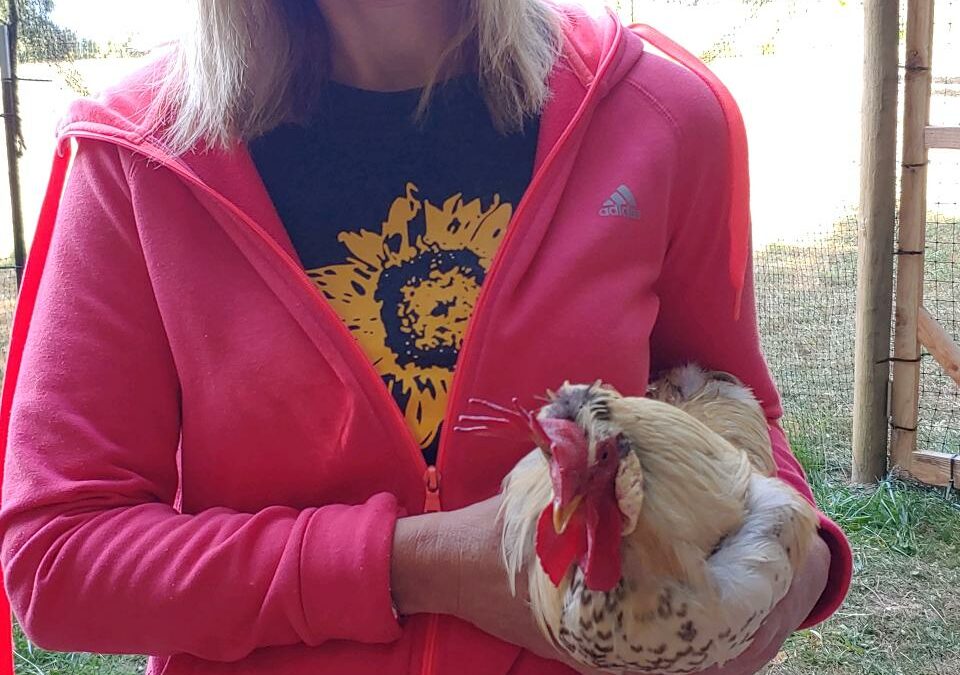
It has been a while since I last wrote about my chicken adventures. In late June, our flock grew to 20. Our three broody hens hatched 14 peeps. At some point, I’ll share that whole rather stressful adventure, but for now, I’ll skip over becoming a chicken grandma and instead turn my attention (and your attention) back to my mean rooster, Oden. If you recall, a few months ago I wrote an article titled “Right Seat, Wrong Chicken.” Oden’s behavior continued to escalate after recovering from the Great Chicken Massacre. It got to the point that I was working my chicken duties around his schedule, i.e., only entering the run when he was in the coop, which resulted in late nights and early mornings. 

A few weeks ago, my chicken coach came to visit. She marched right into the run and headed toward Oden. He sensed her lack of fear and retreated. Then she caught him and put him upside-down. And once a chicken is upside-down, the balance of power shifts—at least for the person who put him upside down. I held Oden for a while, and we eventually let him resume his daily activities. But I soon learned that until I caught him, he would still be aggressive with me. So, the following week—I did it! I caught Oden myself and held him upside down. Now I am at the top of the pecking order, and Oden has become a “Right Chicken, Right Seat” member of my flock.  

I can think of two ways to pivot this story toward business: overcoming our fears or becoming a better leader. Given the current shortage of employees, I’m going to pivot toward leadership. 
Most employers are struggling to find people to fill their open positions, especially people who show up on time and want to do the work. This shortage results in either settling for less-than-ideal candidates or slowing growth until more employees can be hired. 

It might help to think about the reasons for the employee shortage. After surviving the pandemic, many people have changed their priorities, and this shift has impacted the way they view their work. They may be less willing to take a job just to earn a paycheck. Based on my research, there isn’t a shortage of employees, but rather a shortage of enticing opportunities. I’d like to offer up three questions that may help you reframe your approach to attracting and retaining your ideal employee.

1. Is there consistency between what you say you want and what you accept? As we say in EOS, you get what you tolerate. In a time when finding qualified employees is very difficult, it may be tempting to tolerate employee behavior that is contrary to your core values. But that behavior is eroding your culture and lowering the standard for everyone. Addressing that employee with clear examples of the type of behavior that you won’t tolerate is the best way to tackle the problem.  If he or she can’t adjust their behavior, you will need to make the hard decision to let them go. It has been my experience that such decisions are rewarded as other employees step up to fill the void.

2. Are you clear about your vision and your core values?  Are you using those to inform your hiring decisions? A person with passion for your vision who demonstrates your core values on a daily basis will outperform any other employee. If you share your vision and core values during the recruiting and hiring process, the odds of attracting an ideal candidate will increase.  Yes, it will narrow down the number of candidates, but the quality of the candidates will be much higher. 

3. Are you managing your employees in such a way that they can’t imagine not working for you? This can be an uncomfortable question to answer. But if you can answer it in the affirmative, you will have an advantage over other companies competing for the same pool of candidates.  What would it take to have employees who are fiercely loyal to you and your company? (Hint, it isn’t a higher salary.)

If after answering those questions you find that there are opportunities for improvement, I’d like to introduce you to EOS (Entrepreneurial Operating System), an operating system that helps owners and their leadership teams get what they want from their businesses.  When implementing EOS, I teach how to utilize a simple set of tools that help you clarify your vision, gain traction on that vision by instilling discipline and accountability throughout the organization, and then transform your leadership team into a healthy, cohesive, fun-loving group of people who actually like working together.  This system will help you run a better business and, quite frankly, run a better life.  

To get started on regaining control of your business, attracting the right people and accelerating your growth, all you need to do is email me. I can tell you that this system worked for me personally: ever since I addressed my Right Seat, Wrong Chicken issue, I have been able to live a better chicken mama life.


Three Strikes and You Are Out!

Three Strikes and You Are Out!

A few weeks ago, my husband and I went on vacation.  I can’t tell you what the time in the sun did for my mental outlook. I’d highly recommend you take some time to decompress after the stress of the past few years.  However, leaving our house requires finding a dog sitter and a chicken sitter.  Fortunately, we have a chicken whisperer who lives next door who has offered to care for our chickens in our absence.  This woman is an expert in all things chicken.  She is so good with her chickens that she actually takes them on a walk every day – they seriously follow her up and down her driveway.  (As you know, that is not the type of interaction that I have with my chickens.)

Anyway, I knew my chickens were in very capable hands – and that included Oden, should he decide to try any “chicken-business” with her.  (If you are new to my chicken stories, you have missed the adventures of Oden. Here is a link to one article I wrote about him, but essentially, he is a mean rooster who thinks nothing of asserting himself at the top of any pecking order.)

When we returned from our vacation, our chicken whisperer shared that she was up caring for the chickens one afternoon when Oden came up behind her, flogged her and dug his spurs through her boots, causing two 1-inch-deep puncture wounds on her leg.  She kicked him off and chased him away.  But every day after that, he was waiting for her, strutting his stuff in the run.  He wouldn’t go into the coop if she was around.

Well, if you are keeping score, Oden has three strikes: he flogged Mike, he has attacked me multiple times, and now he has flogged our chicken whisperer.

As they say, three strikes and you are out.

Yes, Oden has moved on to greener pastures. And we have a new first in command, Hei Hei (named after a character from the Disney movie Moana).  While I don’t love the name, I’m hoping a gentler name will result in a less aggressive rooster.

It was a hard decision to remove Oden from the flock, as he was really good at his job, and I know his aggressiveness was part of the job. But it is nice to be able to be in the run with the chickens and not have to worry about being flogged.  And I must say that Hei Hei has really embraced being at the top of the pecking order.

How many of you have Odens on your team?  Maybe they are really good at their job, but they are not enjoyable to be around or they are undermining your office culture.

If you are sensing something is wrong with an employee, chances are high that other employees have also noticed, and they are waiting to see how you handle this person.  What kind of message are you sending when you allow this issue to linger?

You don’t necessarily have to let the person go.  But being clear on what defines a great person in your company and then providing feedback on how each employee is performing against that definition is a path that leads toward resolution of “wrong people (chicken)” issues.

The tool we use in EOS is The People Analyzer.  We first help our clients discover their core values. Then we define what those values look like in action.  Upon completion, on a quarterly basis, the clients grade each of their employees on how well they are living and exemplifying the company’s core values.  It redirects those awkward conversations around performance and provides a simple way to communicate where employees are excelling and where they have opportunities to improve.

If you want to be one of those companies that isn’t struggling to find employees during this tight labor market, I’d urge you to define what a great person looks like and then strive to have every employee live it, even when no one is watching. Let those core values become a common language that everyone embodies.  What is the worst that could happen? Oh, I know: you could have a company full of people that you love working with.  And what could be better than that?

If you aren’t sure if you have clearly defined a great person for your company or communicated it to your team, it isn’t too late.  Reach out to me today and I can help you discover exactly what defines a great person in your unique organization.

Cheers to a Good Night’s Sleep

Cheers to a Good Night’s Sleep

One night last week, I felt restless.  I couldn’t fall asleep, as I was thinking about everything I needed to do to prepare for and care for my new “peeps.”  I was thinking about building a bigger chicken coop that could house more chicks, trying to figure out the logistics of having adult chickens and little chicks, imagining places for the little chicks to roost. Finally I sat up and said, “I don’t want to deal with all of this.  All I want is a steady flow of fresh eggs.  I don’t want to worry about facilities, onboarding chicks or dealing with aggressive roosters.”
 
And then I thought, I bet this is how many business owners feel.  I’m sure many of you have had sleepless nights thinking the exact same thing! I don’t want to deal with facilities, HR issues or mask policies.  I just want to make castings! Or I just want to design buildings! Or I just want to (fill in your blank)!
 
If you feel that way, I can understand your frustration (and not just because I’m an aspiring chicken mama).  I work with business owners who once faced those frustrations but are now on a path to a better business and a better life.  
 
Some of those expressed frustrations:

  • One of my clients simply expressed that his level of frustration seemed to be growing exponentially while the business was growing modestly 
  • Another client was tired of the fighting and lack of cohesiveness within the leadership team and said he could see it seeping down into the rest of the organization.
  • The founder of one company had a passionate conversation with me about how she wanted the culture of her organization to attract the best and brightest in the industry but was seeing decisions made moving the company farther from her vision. 

Each of these clients has implemented EOS (Entrepreneurial Operating System) in their organization and are realizing the benefits, including:

  • Clarity on where the organization is going and how it going to get there 
  • Addressing “wrong people, wrong seat” people issues that have been holding the organization back (check out my Right Seat, Wrong Chicken article here)
  • Engaging in tough conversations at the leadership team level, which allows the team to work together on achieving the vision
  • Increased profitability
  • Having more fun

If you feel frustrated that your company isn’t moving towards your vision, or you feel you are working harder and harder and not realizing the benefits of that hard work, or your leadership team isn’t working well together, I can help you.
 
By implementing EOS in your organization, you can put your company on a path towards achieving your vision, align all your employees behind that vision and transform your leadership team into a functional, cohesive group of people who genuinely enjoy working together.  Sound too good to be true?  It isn’t, and many organizations are reaping the benefits of EOS.
 
Email me and we can transform your company as well.  Cheers to more restful nights of sleep in the future!

Effectively Onboarding my new “Peeps”

Effectively Onboarding my new “Peeps”

I want to preface this article with a confession.  When I started writing about chickens over a year ago, I honestly thought I would run out of things to talk about.  I mean, how exciting can chickens be?  And how many ways can you tie chicken mama adventures to business?  But, as recent events have made me realize, I have a lot more to write about.  So, let’s get to it.
 
Two weeks ago, I went up to the coop on Monday morning to let the chickens out.  With all my chicken drama, I am in the habit of counting chickens whenever I go up to the coop.  Well, that Monday morning, I was missing a hen.  I opened the nesting box and there she was: my missing hen, Priscilla, sitting in one of the nesting boxes.  It seemed a bit early to be laying an egg, but at least I could count all my chickens, so I didn’t think much of it. 
 
Until later that day, when I discovered Priscilla was still sitting in the nesting box.  I made sure she was still breathing, and then started to think I might have a broody hen.  
 
What is a broody hen, you ask?  (At least, I hope you are asking, because I had no idea until I began my quest to become a chicken mama.)  A broody hen is a chicken that has decided to sit on and incubate a clutch of eggs.  
 
The next day, I went up to check and sure enough, she was still sitting on her eggs.  So I did the customary check to see how broody she was, and she passed the test (she tried to peck me and growled at me).  
 
As you may recall, I still have Oden, the rooster, so that means we are expecting! 
 
A few days later, we went up to check on Priscilla only to find that we now have two broody hens.  Sally, the lone hen survivor from the big chicken massacre, decided that she also wanted to sit on some eggs.  
 
While I don’t know how many eggs the two of them are sitting on, I think we are somewhere around 12 eggs each.  So we could have a flock of little peeps in the next week or so.
 
Preparing for a new addition to the chicken family is a lot of work.  We had to build a brood hen coop and buy new food, food and water containers for little peeps, and a camera to film the hatching.  I want those peeps to feel like they are welcome into our chicken family.  
 
How many of you are in the process of welcoming new employees into your work flock?  Some people are coming back to the office after an extended work-from-home stint, and many companies are beginning to add new employees to the team due to growth or attrition.  Done properly, the process of onboarding goes beyond taking new hires to lunch on their first day.  It involves helping them acclimate to their environment so they can thrive.  
 
Most likely, it’s been a while since you onboarded anyone. It may be time to dust off your onboarding process and make sure it’s up to date and matches the new workplace environment. 
 
If you don’t think you need an onboarding process, consider the following statistics: 

  • A report from the Society of Human Resource Management found that half of all hourly employees leave within the first 120 days. 
  • Another study completed by the Wynhurst Group found that having an effective onboarding process can increase employee retention by 58 percent and improve employee performance by 11 percent.

Here are some best practices to establish an effective onboarding process for your company:

  1. Establish an onboarding outline.  This outline may vary for each position but should be adapted to suit each new hire. Key aspects include:
    • Expectations of the job;
    • Explanation of how the job contributes to the company’s strategic goals;
    • Job-specific training with key personnel assigned to assist with the training;
    • Company-focused training so the employee understands the business, including its values and culture;
    • Performance goals.
  2. Be prepared for the employee prior to her first day.  What kind of a message does it send if you aren’t prepared?  Paperwork should be ready, a schedule established and team members notified. Having a new employee standing around waiting for you on their first day doesn’t send a welcoming message.
  3. Make onboarding a two-way street. Giving some responsibility to the employee during onboarding helps them gain ownership in the process. For example, you could have an employee list the areas where he feels he needs further training or exposure.
  4. Establish a calendar for onboarding.  What specifically does the company need to do in the 1st day, week, month and beyond?  What specifically is the employee responsible for?  Establishing 30-, 60- and 90-day goals for the employee can help determine if he or she is a good fit for your organization prior to the 90-day review.
  5. Schedule one-on-one meetings on a consistent basis.  During these meetings, both parties should be open to feedback, suggestions and questions.
  6. The onboarding process should extend beyond 90 days.  As the employee becomes a contributing member of the workforce, shift the conversation towards employee development and advancement.

I can tell you that having little chicks grow into laying hens (and hopefully a nicer rooster) seems like a much better option than putting up with Oden and paying an arm and a leg for laying hens.  Similarly, it might pay off to put some energy into developing your new talent into real assets for your organization.   
 
If you feel that your onboarding process could use some help, I have some resources that can help you strengthen it.  Email me today and I’ll share what I have.
 
While you can’t count your chickens before they hatch, you can prepare your new hires to assimilate into your culture and become contributing members to your flock.

Making the Hard Decisions Even When You Don’t Like Your Options

Making the Hard Decisions Even When You Don’t Like Your Options

If you recall, the outcome of the big chicken massacre was a traumatized rooster (Oden) and an unscathed hen (we named her Sally the Survivor). The end result of one hen and a feisty rooster is an oversexed hen.  I needed to solve my immediate problem: finding more hens.  Since I have Icelandic chickens, breeding with other types of chickens isn’t an option.  So, I did what everyone does when faced with a problem these days and turned to social media.  In my Icelandic Chicken Mama Facebook group, I asked if anyone had any hens I could buy in my local area.  Fortunately, there was one woman who agreed to sell me some of her hens though the price was a bit steep.  We did the exchange in the parking lot of Buy Buy Baby in Clackamas, Oregon.
 
I drove them home and planned on waiting until after dark to introduce the hens to their new home and family, but then changed my mind and decided to give them a few hours to acclimate prior to heading to bed for the evening.  Well, that was quite an experience.  Oden, the rooster, was overwhelmed with all his new options, and Sally was less than pleased to have to share Oden’s attention.  I have a video of this introduction if you are looking for a little chicken entertainment.  
 
Now, I wasn’t excited about paying what I paid for my hens, but the reality was that I needed to solve my short-term issue in order to make sure Sally survived.  I considered my options – purchasing chicks, purchasing eggs or paying an arm and a leg for hens.  I picked the best of the less than ideal options and moved toward implementation.  
 
I’m sure there are many of us who haven’t liked our options over the past 16 months.  Wearing a mask, social distancing, not seeing friends, not traveling, cooking all meals at home, etc.  But one thing I’ve learned as an adult is we often have to make hard decisions based on the current situation we are facing.  
 
When I’m implementing EOS with a client, I work to help them get better in three areas: Vision, Traction and Healthy.  Vision means that everyone is clear on where the organization is going and how it will get there.  Traction means no matter where you look in the organization, you see people executing on that vision with discipline and accountability. Healthy means transforming the leadership team into a cohesive, fun-loving group of people who genuinely like working together.  
 
Guess which one is the hardest to do? Yep – transforming the leadership team into a cohesive group of people who are willing to be open and honest with one another.  Conflict is difficult for most people, and as a result, they avoid it.  The sad reality is that avoiding it doesn’t make it go away. In fact, in many ways, it festers and ends up causing more issues than you can imagine.  Engaging in a lively debate is critical to working through the issues facing an organization.  If your leadership team can’t engage in those conversations, the decisions that are being made may be taking you farther from what you are trying to achieve, not closer. 
 
If you sense that your team is not making the hard decisions because they are avoiding conflict, you could be heading for trouble.  If you are ready to take the bold steps to work through those issues but you aren’t sure where to start, I can help you.  Making the difficult decisions now will help position the organization for growth in the future.  Are you ready for a new future?  Email me now and we can start working on achieving it today.